How to plan a 60-second explainer video: script, storyboard and delivery
A good 60-second explainer feels effortless to watch. It is not effortless to make. Most of the work happens before anyone animates a single frame. This guide walks through how we plan a short animated explainer, so you can brief one properly, whether you hire us or someone else.
Start with one idea
An explainer that tries to say five things says none of them. Write one sentence that finishes the line "After watching, the viewer will understand that..." If you cannot finish it in one sentence, the video is really two videos.
Good examples of single ideas: why a product is cheaper to run over a year, how a service works in three steps, why a common myth is wrong. Our own history explainers each answer one question, such as how many Greeks really fought at Thermopylae.
Write for the ear, not the page
People read about 200 to 250 words a minute but listen comfortably at roughly 130 to 160. A 60-second voiceover is therefore about 130 to 150 words. If your script is 300 words, it is a two-minute video, not a one-minute one.
- Use short sentences. If you run out of breath reading one aloud, split it.
- Say numbers in a way people can picture. A distance in kilometres means little; "a stack of people reaching the Moon" sticks.
- Put the hook first. The first three seconds decide whether a viewer stays, especially on Shorts, Reels and TikTok. Open with the question, the surprise or the problem, not your company name.
- End on one clear line and, if you need it, one call to action.
Storyboard before you animate
A storyboard is a frame-by-frame plan: what is on screen, what the viewer hears, what the caption says and how long it lasts. It is the cheapest place to change your mind. Moving a frame on paper takes minutes. Redoing an animated scene takes much longer.
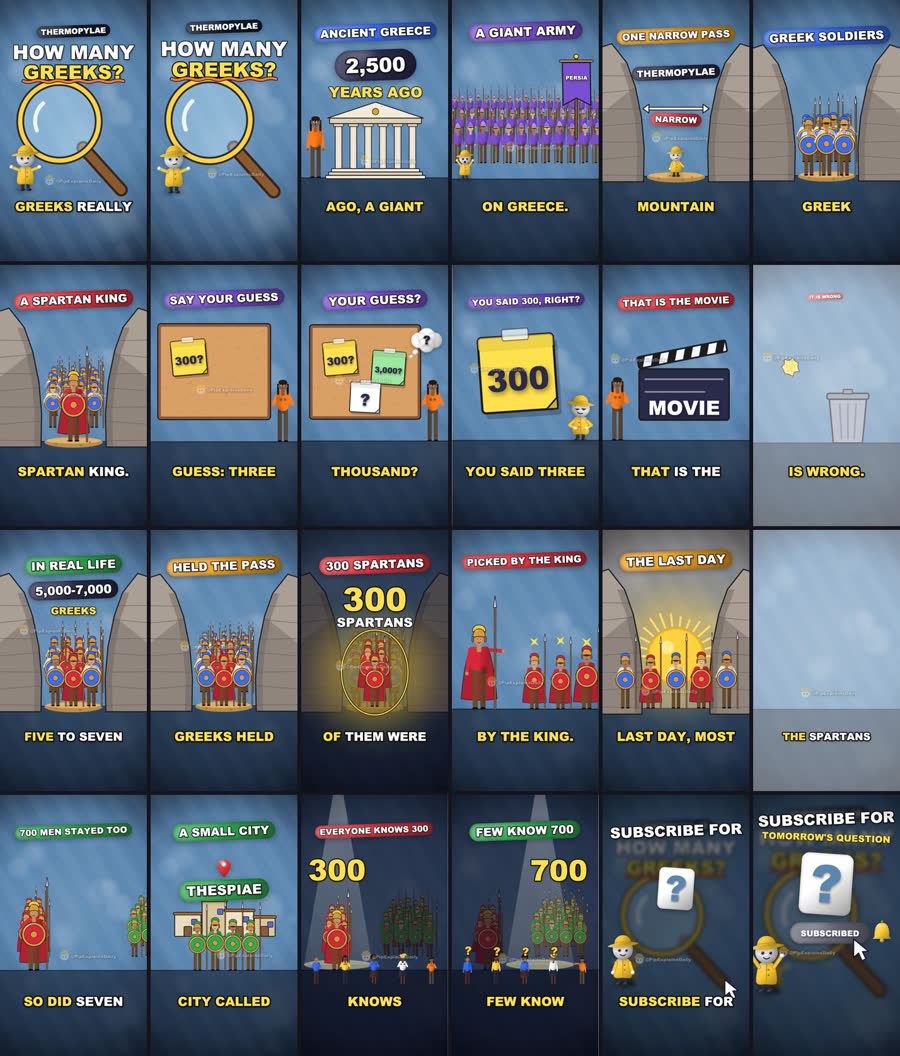
A useful board for a 60-second video has about 20 to 25 frames. Our Thermopylae explainer, shown above, has 23 shots in 47 seconds. That pace, roughly one new picture every two seconds, keeps the eye moving without feeling frantic.
For each frame, decide:
- The picture. One idea per frame, drawn simply.
- The words. The line of voiceover and the on-screen caption.
- The motion. What moves, and what the eye should follow.
- The timing. Fast sections for energy, a calm beat for the reveal.
Approve the board before production starts. That one habit prevents most arguments later.
Design for sound-off
Most short videos are watched without sound at first. Burned-in captions that match the voiceover are not optional. Keep them large, high contrast and inside the safe area, away from the edges where phone interfaces cover the picture.
Pick the right format
- Vertical 9:16 for YouTube Shorts, Instagram Reels and TikTok.
- Widescreen 16:9 for YouTube, websites and presentations.
- Square 1:1 for feeds where vertical would be cropped.
Tell your animator every place the video will appear before the storyboard is drawn. Reframing a finished vertical video into widescreen is rarely a simple crop.
Voice and sound
A voiceover sets the tone more than the pictures do. Decide early whether you want a human recording or a synthetic voice. Both are legitimate, but be open about it. On our own explainers we use AI voices and say so. Add light sound effects at each cut and a quiet music bed if the topic suits it, then mix the voice clearly on top.
What to prepare before you brief us
- The single idea, in one sentence
- Who watches it and where
- Any facts or numbers that must be exact, with sources
- Brand colours, logo and fonts, if you have them
- Two or three videos you like, and what you like about them
- A deadline
If you have no brand yet, read our brand identity checklist first.
Revisions that do not blow up the schedule
Agree the number of revision rounds up front and attach each round to a stage: script, storyboard, animation, sound. Feedback on the storyboard is cheap. Feedback on final sound is expensive if the picture changes. A clear approval at the end of each stage keeps the project moving.
The short version
One idea, a script of about 140 words, a storyboard you approve, captions that work with the sound off, and the right format for where it will be seen. That is a 60-second explainer that people actually finish.
Want one made? See our 2D work or tell us about your project.
Want this made for you?
Creonix Studios makes 2D explainers, storyboards, 3D characters and product renders.
Start a project →